


A boys mullet haircut is a cut with short, tidy sides and a longer back, and the modern version blends the two with fades, tapers, and soft texture so it looks neat instead of messy. It works on straight, wavy, curly, and coily hair, and it can be as short or as long as school rules and your son’s taste allow.
This guide covers 20 styles, face shape matching, age based picks, daily styling, upkeep, barber wording, and common parent mistakes. You will also find grow out timelines, school policy advice, and quick answers to the questions parents ask most before booking the first appointment. Every tip is written to be practical for busy parents.
What Is a Boys Modern Mullet
A boys modern mullet is a haircut with shorter hair on the top and sides and extra length at the nape, blended together with clippers and scissors. The old “business in the front, party in the back” look had a hard line between the two zones. The modern version softens that line with a taper or fade and adds layers for movement.
The shape is back in style with Gen Z, helped by skate culture, football players, and social media videos. Style guides such as Man of Many describe the current mullet as a more subtle, wearable take on the 1980s original. For kids, that means a cut that looks planned instead of grown out by accident.
Here is what sets the modern version apart:
• Blended sides: a fade, taper, or scissor cut replaces the harsh step between short and long hair.
• Controlled back length: the nape hair is trimmed to a chosen length, often between the collar and the shoulders.
• Added texture: layers, choppy ends, and a bit of product give the top natural movement.
How to Choose the Right Version
The best boys mullet haircut is the one that fits his hair, his daily routine, and his school. Walk through these steps before the appointment.
1. Check the school handbook. Look for words like “extreme,” “collar length,” or “off the ears.”
2. Look at his hair type. Straight hair needs texture work, curls need shape, and coils need moisture and a barber who knows them.
3. Be honest about morning time. A slick back needs more effort than an air dried wavy cut.
4. Decide on length. Short backs suit first timers. Longer backs suit boys who can wait through the grow out.
5. Let him have a say. A cut he picks is a cut he will actually style.
The Best Boys Mullet Haircut Variations
These 20 styles cover every hair type, age, and level of boldness. Use them as a menu, then show your barber a photo of the one you like.
1) Classic Boys Mullet

Short top and sides with a clearly longer back and very little blending. Best for boys who want a full statement and have a relaxed dress code. Plan a trim every 4 to 6 weeks to keep the back from looking scruffy.
2) Boys Mullet Fade

The sides are faded with clippers from skin or a short guard into the longer top and back. Ask for a low, mid, or high fade depending on how bold you want it, and expect touch ups every 3 to 4 weeks.
3) Short Mullet Haircut Boy

The back just brushes the collar, so the mullet shape is there without much length. This is the best first mullet for nervous parents.
4) Curly Boys Modern Mullet

Curls are shaped with scissors and layered so each curl stacks neatly instead of puffing out. Ask the barber to cut curls dry or to study the curl pattern first. A leave in conditioner or curl cream keeps the shape defined.
5) Boys Modern Mullet Straight Hair
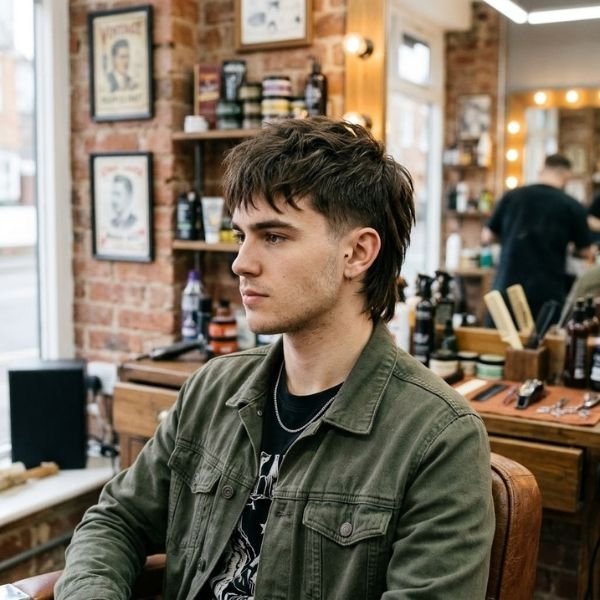
Straight hair can look flat, so this cut relies on layers and choppy ends for movement. A little sea salt spray adds grip without making hair stiff.
6) Tapered Modern Mullet Haircut Boy

A gradual taper runs down the sides and nape instead of a skin fade. The result is softer and more school friendly.
7) Burst Fade Boys Mullet Haircut

A burst fade curves around the ear in a semicircle and leaves the length at the back untouched. It works especially well on curly and coily hair.
8) Sporty Medium Mullet

Medium length keeps the back around the collar so it fits under a helmet, cap, or headband. A good pick for soccer, baseball, and skateboarding kids.
9) Wavy Surfer Mullet for Boys

Natural waves are layered through the top and back for a tousled, beachy shape. It can be air dried with a spritz of sea salt spray.
10) Fringe Mullet

A short fringe sits across the forehead while the back stays long. Keep the fringe above the eyebrows so it does not block his vision at school.
11) Low Fade Modern Mullet

The fade starts low, just above the ear and around the nape, so the look stays subtle. It is neat enough for family events and still reads as a mullet.
12) Longer Back, School Safe

Keep the sides short, the top tidy, and the back long enough to look intentional. Schools often judge on neatness, so a clean neckline and trimmed ears matter more than the exact length. Ask the school what counts as acceptable before you cut.
13) Drop Fade Mullet

A drop fade dips behind the ear and follows the curve of the skull. That curve matches the mullet’s back length, so the whole cut looks like one shape.
14) Temple Fade Modern Mullet

A temple fade tightens the hair around the temples and sideburns while leaving the rest fuller. It adds sharpness without a big commitment.
15) Textured Crop Mullet

A short, choppy top is pushed forward over a short mullet back. It takes about a minute to style with a matte paste.
16) Slick Back Mullet

The top is brushed straight back with a water based pomade and flows into the mullet length. It needs about three to four inches on top. Best for teens and special events such as school dances or weddings.
17) Mohawk Mullet (Mohawk-Style)

A longer center strip runs from the front to the back, with shorter sides and a longer nape. It is bold and playful. Many schools list mohawk styles as banned, and Waverley College, a Catholic boys school in Sydney, made headlines for charging students a haircut fee on the first day of term. Always check the rules first.
18) Edgy Line-Up Mullet

Crisp edges around the forehead and temples frame the mullet and make it look sharp. A line up needs a refresh every 2 to 3 weeks. For young boys, ask the barber to keep the hairline natural and not push it back.
19) Long Boys Mullet Haircut

The back reaches past the collar toward the shoulders while the top and sides stay shorter. It takes patience and regular conditioning to avoid tangles.
20) Boys Mullet Haircut for Black & Textured Hair

Coils and tight curls hold a mullet shape very well. Fade the sides with clippers, keep volume on the top and back, and let the natural texture do the work. Choose a barber who has experience with 4A to 4C hair. At home, moisture, a satin bonnet or pillowcase, and gentle detangling protect the length.
Matching the Cut to Face Shape
| Face Shape | Best Mullet Style | Why It Works |
| Oval | Almost any, including the classic and the fade versions | Balanced proportions suit most lengths |
| Round | Tapered mullet or burst fade with height on top | Height and tight sides add length to the face |
| Square | Textured crop mullet or fringe mullet | Soft texture balances a strong jawline |
| Oblong | Fringe mullet with less height on top | The fringe shortens the look of a long face |
| Heart | Fringe mullet with a fuller back | Extra length at the nape balances a narrow chin |
Boys Mullet Styles by Age Group
A five year old and a fifteen year old should not wear the same mullet. Age changes how long the back should be, how sharp the fade should look, and how much styling he can handle.
Little Boy Mullet Fade
For ages 3 to 8, keep the back short and use a low fade or taper behind the ears. Ask the barber to use scissors near the ears because kids wiggle. Short sessions and a snack make the appointment smoother.
Older Boys Mullet Haircut
For ages 9 to 17, there is room for more length, stronger fades, and styles like the slick back or the fringe mullet. Let him pick the reference photo and learn how to style it. A cut he understands is far easier to maintain.
Boys Mullet Haircut Photo Gallery and Inspiration
A good photo is the fastest way to get the cut you want. Build a small gallery on your phone before the visit so the barber can see exactly what you mean.
• Save three to five photos that show the front, side, and back of the style.
• Pick photos with hair texture close to your son’s, such as curly with curly and straight with straight.
• Mark the back length you like by pointing to where it ends on the neck.
Quick Age and Care Guide
| Age Range | Suggested Back Length | Trim Schedule | Daily Styling |
| 3 to 6 | Above the collar | Every 4 to 5 weeks | Comb and light cream |
| 7 to 10 | At the collar | Every 4 weeks | About 2 minutes with paste |
| 11 to 13 | Collar to mid neck | Every 3 to 5 weeks | Blow dry and texture spray |
| 14 to 17 | Mid neck to shoulder | Every 3 to 4 weeks | Personal choice and product |
Daily Styling That Kids Can Do
A mullet should not take longer than five minutes to style. Teach your son this simple routine so he can do it himself.
1. Start with damp hair after a shower.
2. Comb through the back with a wide tooth comb, working from the ends up.
3. Add a pea sized amount of cream for curls or a few sprays of sea salt spray for straight and wavy hair.
4. Dry with a hairdryer on a low setting, or let it air dry for a natural look.
5. Finish the top with a small amount of matte clay or paste and shape it with fingers.
Care and Upkeep
A mullet looks best when the sides stay clean and the back stays healthy. Small habits make a big difference.
• Wash smart: 2 to 3 times a week for straight or wavy hair, and less often for curls or coils.
• Condition the back: the longest hair is the oldest, so it dries out and tangles first.
• Detangle gently: use a wide tooth comb and start at the ends, never the roots.
• Trim on time: fades need touch ups every 3 to 4 weeks, while scissor trims can wait 6 to 8 weeks.
• Protect at night: a satin pillowcase reduces frizz and breakage.
Barber Talk That Works
Clear words save time and prevent bad surprises. Bring a photo, then use simple terms to describe the cut. Clipper guard numbers help: a number 1 guard leaves about 1/8 inch, a number 2 about 1/4 inch, and a number 3 about 3/8 inch.
Here is a sample script you can adapt:
• “We want a modern mullet with a low taper on the sides, starting at a number 1 guard.”
• “Please keep the top about three inches with some layers for texture.”
• “Leave the back at collar length with a natural, tapered neckline.”
• “We need to keep it school friendly, so please keep the ears clear and the line neat.”
A natural neckline grows out more evenly than a squared one.
Common Mistakes Parents Make With This Cut
Most bad mullets come from a few avoidable errors. Watch for these.
1. Cutting the back too short at the start. Short backs lose the mullet shape and take months to recover.
2. Skipping the school rules. A cut that breaks the dress code can mean a forced haircut.
3. Choosing a barber with no experience. Textured and curly hair need specific cutting skills.
4. Going too high on the fade. A high fade looks dramatic and grows out unevenly.
5. Using too much product. Heavy gels and waxes weigh down kids’ hair.
6. Forgetting maintenance. Without regular trims, the back looks messy and the sides lose their shape.
Is a Mullet Good for School
A mullet is good for school only if the school allows it. Rules vary a lot by country, district, and even by grade level. Some schools welcome it, and others ban it outright.
Several Australian private schools have banned the style. Trinity College in Perth told parents that it sets high standards for personal presentation, and Waverley College in Sydney made students with mullets, mohawks, and similar cuts visit a hairdresser.
Law firm Colin Biggers & Paisley, in its guide on mullets and school dress codes, notes that dress codes should be clear, applied evenly, and free of discrimination between boys and girls. That is Australian guidance, so US and UK families should read their own school’s handbook. To stay safe, choose a short or tapered version with a clean neckline, and ask the school office for a written answer if the rules are unclear.
How Long Does a Mullet Take to Grow
Scalp hair grows about half an inch per month, or roughly six inches per year, according to dermatology based guidance. That means a boy with a short crop needs about 6 to 8 months to grow a collar length back.
Here is a rough timeline for the back length:
• 2 inches: about 4 months
• 4 inches: about 8 months
• 6 inches: about 12 months
Tightly coiled hair often looks shorter because of shrinkage, and small studies suggest group averages may be a bit slower. Individual boys vary widely, so use these numbers as a rough guide only.
The awkward middle phase is the hardest part. Keep the sides trimmed and the neckline clean while the back grows, and the cut will look intentional the whole way.
FAQs Parents Actually Ask
Will my son’s school allow this?
It depends on the school. Read the handbook, ask the office, and pick a short tapered version if unsure.
Does curly hair work for a mullet?
Yes. Curls stack well into a mullet shape when layered and kept moisturized.
How do I stop him from hating it after one week?
Start with a short version, let him pick the photo, and teach him a quick styling routine.
Conclusion
A boys mullet haircut can be short and tidy, long and bold, or anything in between. The key is matching the style to his hair type, age, and school rules, then keeping it fresh with regular trims and simple daily care. Start with a photo, pick a barber who knows his hair, and keep the first cut conservative.
Which of the 20 styles is your son leaning toward? Share your pick in the comments, and send this guide to another parent who is planning a first mullet.
