


A low taper fade textured fringe is a haircut with short, softly blended sides and a longer, choppy top styled forward over the forehead. The taper starts low near the ears and neckline, so the cut looks tidy without the harsh contrast of a skin fade.
The fringe, which is the front section of hair that falls toward the brow, is cut with layers so it moves and separates. It suits most hair types and needs little upkeep. This guide covers 12 looks for 2026, how the cut compares with a mid taper, how to style it on straight, wavy, and curly hair, which face shapes suit it, and how often to see your barber.
Why the Low Taper Fade Textured Fringe Is Trending
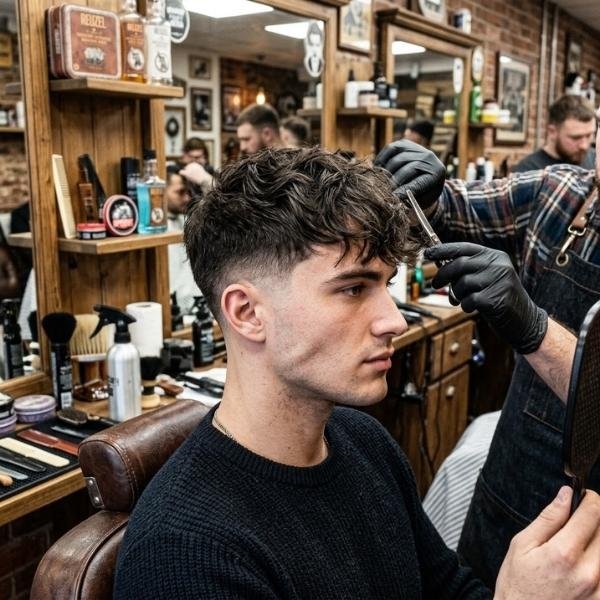
Most men want a cut that looks sharp at work and relaxed on the weekend. The low taper handles the sharp part. The textured fringe handles the relaxed part.
It also grows out well. Because the taper sits low, there is less contrast between the shortest and longest hair, so the shape holds for weeks. Barbers like it because it adapts to fine straight strands, loose waves, and tight curls.
Here are 12 looks to bring to your next appointment, with what to ask for and who each one suits.
Messy Textured Fringe Low Taper Fade
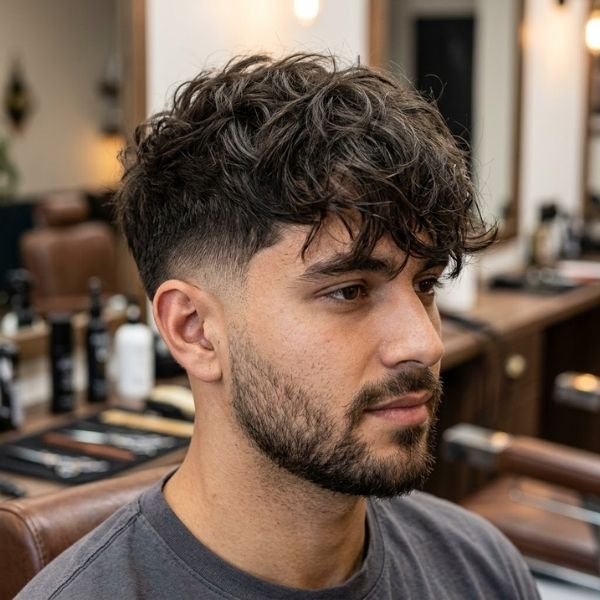
This is the easiest entry point. The barber uses point cutting, which means snipping into the hair tips at an angle to create broken, uneven ends. The fringe is then dried forward and roughed up with matte paste.
It suits straight or slightly wavy hair of medium thickness. Go easy on product. The mess should look slept in, not wet.
Curly Textured Fringe with Low Taper

Curls already carry their own texture, so the cut focuses on shape. Your barber rounds the fringe so it sits just above the brows and keeps the sides tapered close.
The low taper stops the sides from puffing out, which keeps attention on the curls on top. A leave in cream and a gentle scrunch usually do the job.
Blowout Textured Fringe Low Taper

A blowout adds height at the front. You dry the hair up and forward with a blow dryer, then set it with clay. The blowout taper often leaves a little extra length near the crown for lift.
This look works best on thick or wavy hair that can hold volume. Ask for roughly 3 to 4 inches on top.
Read More: Long Buzz Cut Fade: The Complete Guide to Guards, Fades, and Styling
Wavy Fringe Low Taper Fade

Wavy hair is a natural fit. The waves already break into soft pieces, so your barber mostly removes weight and lets the pattern form the fringe.
Apply a light cream or mousse to damp hair and let it dry. Brushing dry waves turns them into frizz, so use your fingers instead.
Straight Hair Textured Fringe Taper

Straight hair needs more help to look textured. Barbers use thinning shears or a razor to add movement inside the fringe, since the hair will not do it alone.
Texturizing powder at the roots and a matte clay on the ends give the grip straight hair lacks. Fine hair looks best with a shorter fringe.
French Crop Textured Fringe with Low Taper
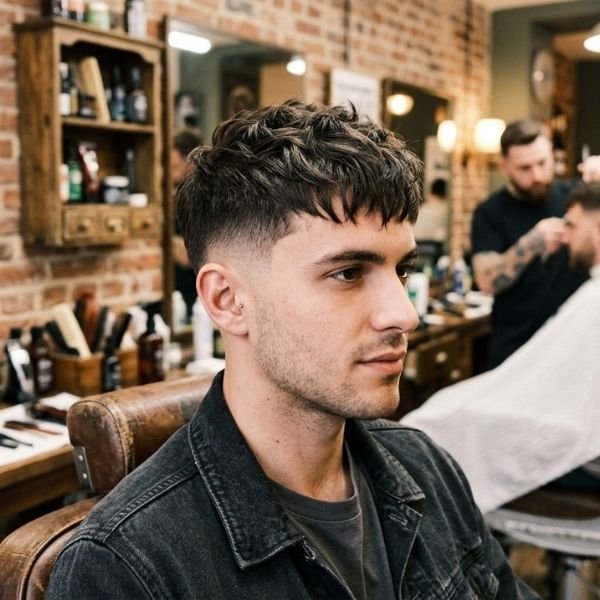
A French crop is a short, blunt fringe cut straight across the forehead with tight sides. The textured version breaks that line with point cutting so it looks less severe. You can see more variations in Luxe Digital’s guide to textured crop haircuts, a men’s style publication that groups crops by fade type.
Pairing the crop with a low taper softens the whole shape. Keep the fringe around 1 to 2 inches for a clean look.
Asian Textured Fringe Low Taper

Many men of East and Southeast Asian descent have straight, thick, strong hair that falls heavily and can flatten a fringe. Hair varies from person to person, but weight removal is usually the key step.
Ask the barber to thin the inside of the top with slide cutting, where open scissors glide down the strand. Dry the roots with a blow dryer for lift, then finish with a strong hold matte clay.
Fluffy Fringe Low Taper Fade

This look is all about soft volume. The top stays a bit longer, around 3 to 4 inches, with light layers so the hair lifts instead of lying flat.
Use a volumizing spray and dry the fringe with your fingers. Heavy gel kills the fluff, so keep the product light.
Mid-Length Textured Fringe with Low Taper

Here the top runs about 4 to 6 inches and the fringe reaches the eyebrows or lower. The low taper keeps the sides neat so the extra length looks planned.
You can sweep it to the side or push it forward. It needs more product and more frequent shaping, but it is a smart stage while you grow your hair out.
Textured Fringe with Beard and Low Taper

The taper on the sides should blend into the beard so there is no hard break at the sideburns. A good barber fades the two together in one pass.
Keep the beard trimmed to suit the fringe. A short to medium beard with a clean neckline frames the face without overwhelming it.
Short Textured Fringe with Low Taper

This is the low effort version. The top sits around 2 to 3 inches and the fringe is short, so mornings take two minutes.
It suits busy schedules, gym routines, and warm weather. Ask for texture through point cutting so the short fringe still looks lived in.
Textured Fringe Low Taper with Mullet

A mullet is short at the front and sides with extra length at the back. Modern versions are softer and more layered than the 1980s original.
The low taper cleans up the sides so the back length looks deliberate, while the textured fringe connects the front to the rest. Ask for layers in the back, not a blunt edge.
What Is Low Taper Fade Textured Fringe

A low taper fade textured fringe is a men’s haircut that pairs a gradual taper on the sides and back with a longer, layered top that falls forward as a fringe. The taper begins just above the ears and follows the natural hairline down to the nape, which is the back of the neck.
Think of it as two haircuts in one. The bottom half is precise and neat. The top half is loose and expressive.
These are the three parts your barber works on:
• The low taper: sides and back are clipped shortest at the hairline and get gradually longer going up. Clipper guards are numbered by length. A #1 guard leaves about 1/8 inch and a #2 leaves about 1/4 inch.
• The textured fringe: cut with scissor techniques such as point cutting or slide cutting so the ends separate instead of forming one heavy block.
• The blend: the barber joins both zones with scissor over comb, a method where scissors trim the hair lifted by a comb for a smooth transition.
A taper differs from a full fade because it usually keeps some length at the sideburns and neckline instead of cutting down to bare skin. For a wider look at taper cuts, Luxe Digital has an illustrated taper fade haircut guide.
Read More: 21 Best Kids Mullet Haircuts for Boys and Girls in 2026
Low Taper Fade vs Mid Taper for Textured Fringe
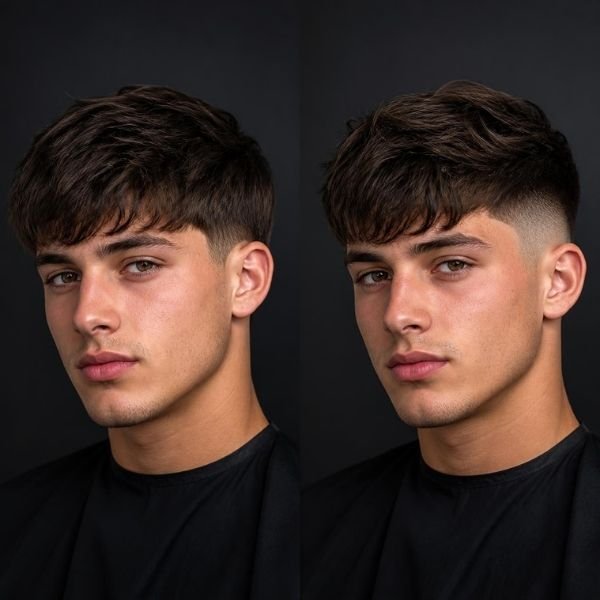
The difference comes down to where the taper starts. A low taper stays near the ears and nape. A mid taper begins around the temples and sits higher on the head.
| Feature | Low Taper | Mid Taper |
| Starting point | Just above the ear and nape | Around temple height |
| Contrast with the top | Soft and subtle | Clearer and more defined |
| Grow out | Graceful and gradual | Shows sooner |
| Typical refresh | Every 3 to 4 weeks | Every 2 to 3 weeks |
| Best vibe | Polished and relaxed | Bold and modern |
Low Taper Fade Textured Fringe
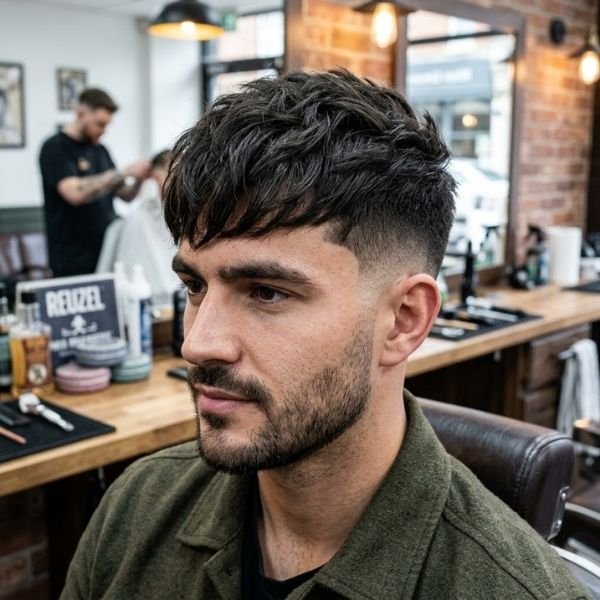
The low version keeps the focus on the top. The sides stay quiet, so the fringe becomes the main feature.
A low taper fade textured fringe works in offices, schools, and casual settings. It is also the best pick if you are trying a fade for the first time.
Mid Taper Fade with Textured Fringe
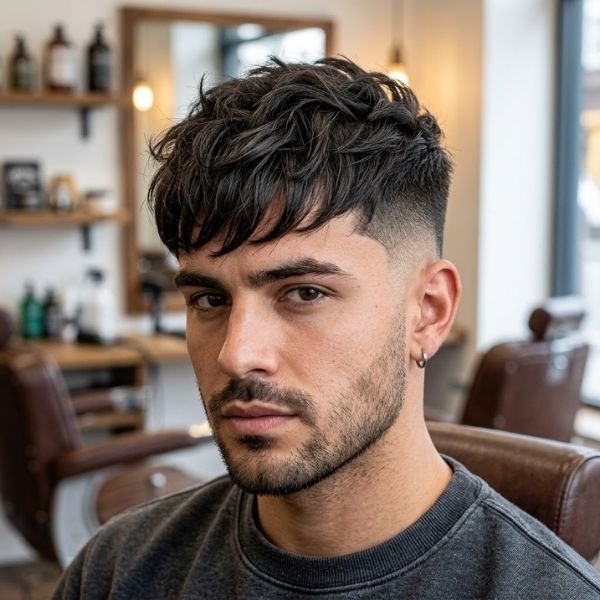
The mid taper removes more hair from the sides, which makes the fringe look fuller by comparison. The look is sharper and more graphic.
It suits men with strong jawlines or thick hair who want clear shape. Expect to go back sooner to keep the lines crisp.
Textured Fringe Low Taper from Different Angles
A cut can look great from the front and fall apart from behind. Check it from every side before you leave the chair.
Front View of a Textured Fringe Low Taper
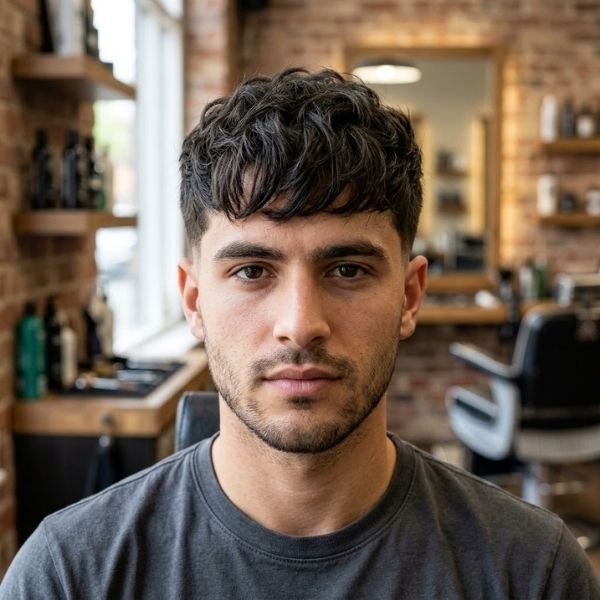
From the front you should see a fringe that lands between the eyebrows and the hairline, with broken, separated ends. The sideburns should be shaped, not left bulky, and the taper should be barely visible.
• The fringe falls evenly without one heavy clump
• Temples are clean and the taper blends upward
• The hairline looks natural, not pushed back
Back View and Tapered Finish

The back view shows the quality of the taper. Hair should shorten smoothly toward the neck with no visible lines or steps.
You also choose the neckline. A tapered neckline fades into the skin and grows out softly. A squared or blocked neckline looks crisper but loses its shape faster.
How to Style a Low Taper Fade Textured Fringe

The cut does half the work. Styling a low taper fade textured fringe well decides whether the texture shows. A few basic products cover most needs: sea salt spray, which is a mist that adds grit and hold, a matte clay or paste, and texturizing powder.
Creating Texture and Definition
1. Towel dry your hair until it is damp, not dripping.
2. Mist sea salt spray through the top and fringe.
3. Blow dry the fringe forward, using your fingers to lift at the roots.
4. Warm a pea sized amount of clay between your palms.
5. Rake it through from back to front.
6. Pinch and twist the ends to define the pieces.
7. Finish with a light hold spray only if needed.
Use less product than you think. You can always add more, but you cannot take it out without washing.
Styling Straight, Wavy, and Curly Hair
Each hair type needs a slightly different approach. These are the basics:
• Straight hair: add grip with texturizing powder at the roots and matte clay on the ends.
• Wavy hair: use a light cream or mousse on damp hair and scrunch gently, then let it air dry.
• Curly hair: apply a leave in cream, scrunch, and dry with a diffuser on low heat to keep the curl pattern together.
A diffuser is a dryer attachment that spreads airflow so curls do not get blown apart.
The Evolution of Low Taper Fade Textured Fringe
Tapered cuts come from classic barbering, where scissor over comb work gradually shortened hair toward the neckline. Fades later moved into mainstream style through US barbershop culture in the late 20th century.
Short, forward fringes also have a long history, from the Caesar cut, a short cropped fringe named after ancient Roman portraits, to the textured crop and French crop that grew popular in the 2010s.
Short video platforms pushed the low taper fade textured fringe into the spotlight during the 2020s. Videos made it easy to show the before and after. In 2026 the trend leans softer, with longer tops, gentler tapers, and mullet crossovers.
Read More: Low Fade Haircut Men: 22 Fresh Styles for a Sharp Look
Choosing the Right Fit for Your Face Shape
| Face Shape | Fringe Length | Styling Tip |
| Oval | Almost any length | Try any look on this list |
| Round | Medium, with height | Lift the top and keep sides tight to add length |
| Square | Softer, textured fringe | Messy texture softens strong angles |
| Heart | Fuller, brow length | Cover part of a wide forehead |
| Diamond | Mid to long fringe | Bring width to the forehead area |
| Oblong | Short to medium, full | Avoid too much height on top |
Maintenance Tips to Keep the Cut Sharp
The low taper grows out kindly, but it still needs care. Follow these habits to keep the cut looking fresh:
• Book a taper refresh every 3 to 4 weeks, or every 2 to 3 weeks if you like the lines razor crisp.
• Get the fringe reshaped every 6 to 8 weeks so the layers do not turn heavy.
• Wash with shampoo 2 to 3 times a week to avoid drying out your scalp.
• Use a clarifying shampoo, which removes product buildup, once every week or two.
• Keep the neckline tidy between visits, but leave the taper itself to your barber.
• Replace heavy waxes with matte clay or paste if the fringe feels stiff.
Small habits add up. A clean scalp and light product use keep the texture looking natural.
Conclusion
The low taper fade textured fringe works because it balances order with attitude. The low taper keeps things neat, and the textured fringe adds personality. With 12 looks to pick from, there is a version for almost every hair type and face shape.
Pick one look, take a photo to your barber, and describe the taper start point and fringe length. Which of the 12 looks are you trying first? Tell us in the comments and share this guide with a friend who needs a new cut.
FAQ’s
What is a low taper fade textured fringe?
It is a haircut with short sides that taper gradually from the ears and neck, paired with a longer, layered fringe on top.
How do I ask my barber for it?
Say “low taper fade textured fringe” and name your top length, such as 3 inches. Bring a photo to avoid confusion.
How often should I get a trim?
Every 3 to 4 weeks keeps the taper clean. The fringe can wait 6 to 8 weeks.
Does it work on curly hair?
Yes. The taper controls the sides while the curls form a natural textured fringe on top.
What is the difference between a low taper and a mid taper?
A low taper starts near the ears and nape, while a mid taper starts around the temples and looks bolder.
Is it good for thin or fine hair?
Yes, with a shorter fringe and texturizing powder. Fine hair looks fuller when the top is kept short and layered.
Which products work best?
Sea salt spray, matte clay, and texturizing powder give the best natural texture. Avoid shiny gels.
Is it appropriate for work?
Yes. The low taper keeps the outline neat, so the cut suits most offices when styled with light product.
